Deciding whether to extend your current home or move elsewhere is one of the most important decisions a homeowner can make. Both options come with financial implications, lifestyle changes, and varying levels of disruption. While moving can offer a fresh start, extending gives you the opportunity to improve what you already have without leaving behind a familiar environment.
The challenge is that there is no universal right answer. What works for one homeowner may not work for another, depending on factors such as budget, location, property type, and long-term plans. This is why a structured approach is essential when weighing up the options.
Many people assume that moving is the easier route when space becomes limited or the layout no longer works. However, once costs, stress, and market conditions are factored in, extending can often become the more practical and financially sound option.
This guide breaks down the key considerations so you can make a confident decision. By understanding the trade-offs between extending and moving, you can choose the path that delivers the best outcome for your home, your finances, and your lifestyle.
A well-informed decision requires more than a quick comparison of costs. It involves understanding how each option affects your day-to-day life, your future plans, and the long-term value of your property.
Taking the time to properly assess your situation helps avoid costly mistakes. Whether you decide to extend or move, the goal is to create a home that works better for you now while also supporting your future needs.
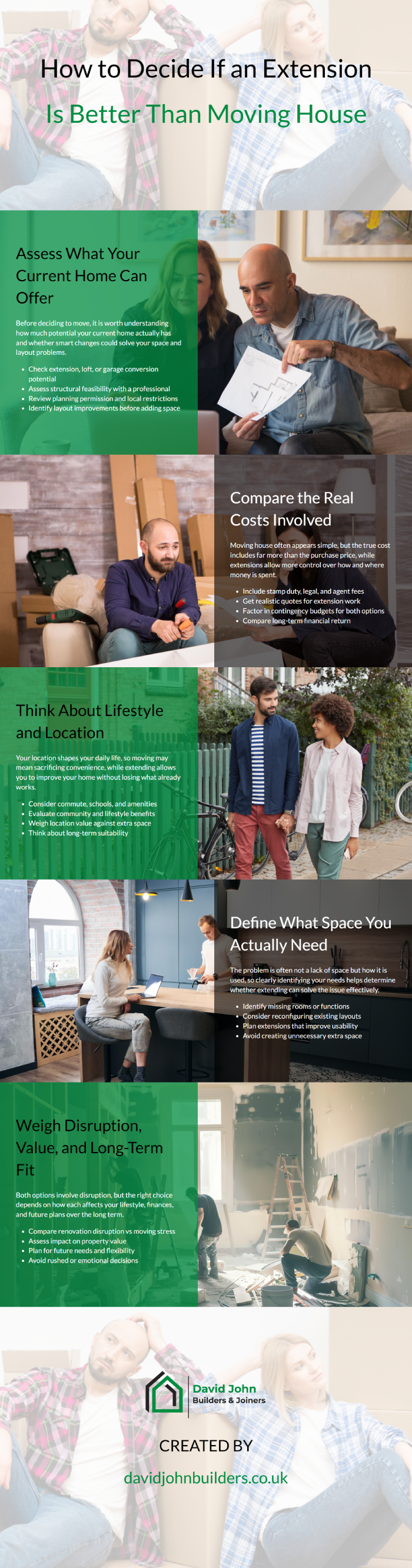
Assess Your Current Property’s Potential
Before considering a move, it is essential to fully understand what your existing property can offer. Many homes have untapped potential that can be unlocked through thoughtful design, reconfiguration, or extension. Without assessing this properly, homeowners can underestimate what is possible.
Looking at your property objectively allows you to identify opportunities for improvement that may not be immediately obvious. This includes considering structural possibilities, available outdoor space, and how the current layout could be adapted to better suit your needs.
Not every property will be suitable for extension, but many can be transformed significantly with the right approach. Understanding these limits early prevents wasted time and unrealistic expectations.
A professional assessment can help highlight what is achievable and what is not. This ensures that any decision to extend is based on facts rather than assumptions.
- Check available space for rear, side, or upward extensions
- Consider loft or garage conversion opportunities
- Assess structural feasibility with a qualified professional
- Review planning permissions and local restrictions
Compare the True Cost of Moving vs Extending
At first glance, moving may seem straightforward financially, but the true cost is often underestimated. Stamp duty, legal fees, estate agent commissions, and removal costs can quickly add up. These expenses can significantly increase the overall cost of relocating.
Extensions also require investment, but the costs are typically more controllable. You can phase work, adjust specifications, and manage budgets more flexibly than you can when purchasing a new property.
It is important to compare both options in full, rather than focusing only on headline figures. A detailed financial breakdown provides a clearer picture of which route offers better value.
Taking a long-term view is also important. Consider not just immediate costs, but how each option impacts your financial position over time.
- Calculate total moving costs including all fees and taxes
- Obtain realistic quotes for extension projects
- Include contingency budgets for unexpected expenses
- Compare long-term value gained from each option
Consider Location and Lifestyle Factors
Your location is one of the most valuable aspects of your home, and it cannot be changed. If you already live in an area that suits your lifestyle, moving may mean sacrificing convenience, community, and familiarity.
Extending allows you to stay in the same location while improving your living space. This is particularly valuable if you are close to good schools, transport links, or social networks.
Lifestyle factors often carry more weight than homeowners initially realise. Daily routines, commute times, and access to amenities all contribute to overall quality of life.
Moving may offer more space, but it can come with compromises that affect your day-to-day living. These trade-offs should be carefully considered.
- Evaluate proximity to work, schools, and transport
- Consider local amenities and community connections
- Assess long-term suitability of your current area
- Weigh lifestyle benefits against additional space
Define Your Space Requirements Clearly
A lack of space is one of the most common reasons homeowners consider moving. However, the issue is often not the amount of space, but how effectively it is used. Poor layouts can make homes feel smaller than they actually are.
Defining your exact needs helps determine whether an extension is the right solution. This means identifying what is missing and how additional space would improve functionality.
Extensions can solve specific problems such as lack of open-plan living, additional bedrooms, or dedicated workspaces. However, adding space without clear purpose can lead to wasted investment.
A well-planned extension should enhance how the home works, not just increase its size. Clarity at this stage leads to better design decisions.
- Identify which rooms or functions are lacking
- Consider reconfiguring existing space before extending
- Plan extensions that improve usability, not just size
- Avoid creating rooms that will rarely be used
Understand Planning and Structural Constraints
Extending a property is not always straightforward. Planning regulations, building constraints, and structural limitations can all impact what is possible. These factors must be understood before committing to a project.
Local planning rules vary depending on property type and location. Some extensions may fall under permitted development, while others require full planning approval.
Structural considerations also play a key role. Load-bearing walls, foundations, and access points can all affect design and cost.
Failing to account for these factors early can lead to delays and increased expenses. A realistic understanding ensures smoother project execution.
- Check permitted development rights and limitations
- Consult local planning authorities if required
- Assess structural implications with professionals
- Factor in timelines for approvals and permissions
Factor in Disruption and Project Timelines
Both moving and extending involve disruption, but in different ways. Moving can be intense but relatively short-term, while extending often involves months of construction work.
Living through a renovation can be challenging, particularly for families. Noise, dust, and restricted access can impact daily routines.
However, moving also brings its own stresses, including packing, coordinating timelines, and dealing with property chains. Delays are common and can be difficult to control.
Understanding how each option affects your lifestyle during the transition period is essential. This helps you choose the option you are better prepared to handle.
- Consider how long construction work will take
- Plan for temporary living arrangements if needed
- Factor in potential delays when moving house
- Assess your tolerance for disruption
Evaluate the Impact on Property Value
One of the key considerations is how each option affects the value of your property. A well-designed extension can significantly increase value, but only if it aligns with market expectations.
Over-extending can reduce returns if the property exceeds the value ceiling of the area. It is important to understand local property values before investing heavily.
Moving to a more expensive property may increase value, but it also comes with higher financial commitment. The return on investment should be carefully considered.
A balanced approach ensures that money spent contributes to long-term value rather than short-term satisfaction.
- Research local property values and ceilings
- Focus on high-impact improvements such as kitchens and living space
- Avoid over-investing beyond market limits
- Consider resale appeal when designing extensions
Consider Emotional Attachment and Practical Comfort
Homes are not purely financial assets, they are also personal spaces filled with memories and routines. Emotional attachment can play a significant role in the decision-making process.
Extending allows you to retain what you love about your home while improving its functionality. This can be particularly important for families who value stability.
Moving may offer a fresh start, but it can also mean leaving behind familiar surroundings. This adjustment should not be underestimated.
Balancing emotional and practical considerations helps ensure that the final decision feels right both logically and personally.
- Reflect on your attachment to your current home
- Consider the impact of change on family members
- Evaluate comfort and familiarity
- Balance emotional factors with practical needs
Plan for Future Needs and Flexibility
When deciding whether to extend or move, it is important to think beyond your current situation. Your needs may change over time, and your home should be able to adapt accordingly.
Extensions can be designed with flexibility in mind, allowing spaces to serve multiple purposes. This adds long-term value and usability.
Moving may solve immediate issues, but it may not address future needs. A forward-thinking approach ensures that your decision remains beneficial over time.
Planning for the future reduces the likelihood of needing another major change in the near future.
- Design spaces that can adapt to changing needs
- Consider future family or lifestyle changes
- Avoid short-term solutions that limit flexibility
- Focus on long-term usability and comfort
Weigh Up the Practicalities of Moving
Moving house involves a complex process that can be unpredictable. Property chains, negotiations, and timing issues can all create challenges that delay completion.
There is also the risk of sales falling through, which can lead to additional stress and costs. These uncertainties should be factored into your decision.
Extending, while disruptive, often involves fewer unknown variables. Once the project begins, the process is generally more controlled.
Understanding the practical differences between the two options helps you prepare for what lies ahead.
- Consider risks associated with property chains
- Factor in potential delays and uncertainties
- Plan for logistics such as packing and moving
- Compare complexity with extension projects
Avoid Common Decision-Making Mistakes
Many homeowners make decisions too quickly, often driven by frustration or short-term pressures. Without proper planning, this can lead to choices that do not deliver the desired outcome or long-term value.
Taking a structured approach allows you to evaluate both options objectively. This means looking beyond initial assumptions and considering all relevant factors, including cost, practicality, and future needs.
Rushing into either moving or extending without full understanding can result in overspending or regret. Careful planning reduces risk and improves the likelihood of a successful outcome.
Seeking professional advice where needed can provide clarity and confidence. A well-informed decision is always more effective than one based on guesswork.
- Avoid underestimating the full cost of either option
- Do not overlook planning or structural limitations
- Resist making purely emotional decisions
- Seek expert advice before committing
Conclusion
Deciding whether to extend your home or move house requires careful thought and a clear understanding of your priorities. There is no one-size-fits-all answer, but by breaking the decision down into key factors, you can identify which option offers the best overall outcome.
Extending often provides the opportunity to improve your home without sacrificing location or lifestyle. When planned correctly, it can deliver both increased functionality and long-term value. However, this is only viable if the property has the potential to support those changes.
Moving, on the other hand, can offer immediate solutions but comes with higher costs and potential compromises. It is important to weigh these factors against what you would gain from extending.
Ultimately, the right decision is the one that aligns with your long-term goals, financial position, and lifestyle needs. By taking a structured and realistic approach, you can move forward with confidence and create a home that truly works for you.