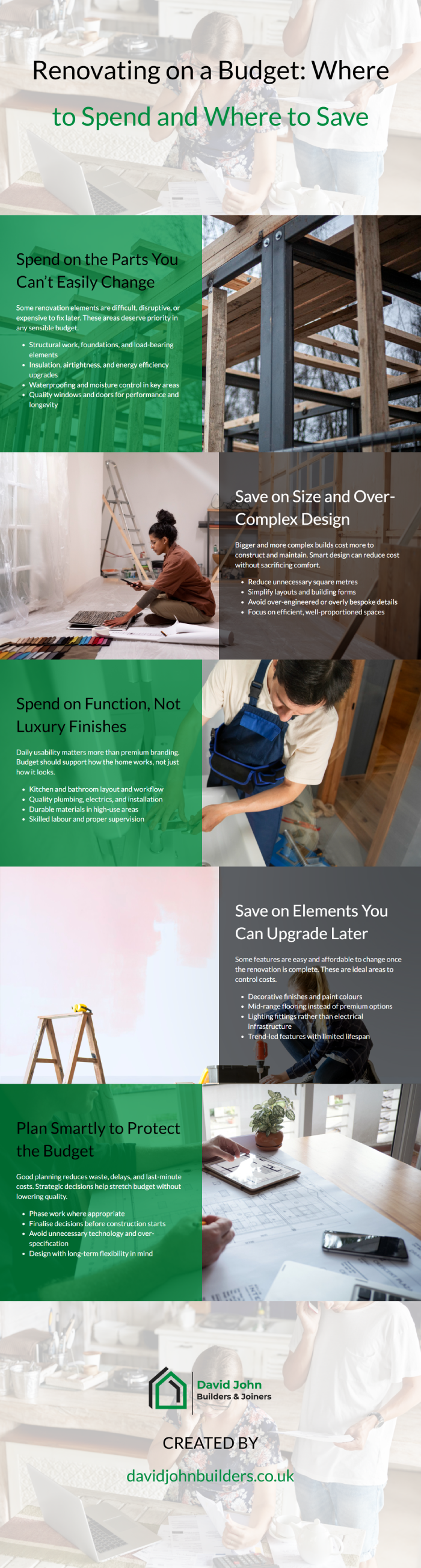
Renovating on a budget does not mean cutting corners or accepting poor quality. It means making informed decisions about where money genuinely adds long-term value and where costs can be controlled without compromising performance or comfort. Many budget overruns happen not because homeowners lack funds, but because they spend in the wrong places.
The challenge during renovation is that every choice feels important. Kitchens, bathrooms, finishes, and features all compete for attention, while less visible elements are often overlooked. Once work is complete, homeowners frequently realise they invested heavily in items that offer little lasting benefit, while underfunding areas that matter most.
This guide explains how to renovate on a budget by focusing spend where it counts and saving where it makes sense. By understanding the real impact of different decisions, homeowners can achieve a high-quality result without unnecessary expense or regret.
Spend on Structural Work and Building Fabric
Structural integrity is the foundation of any successful renovation. Money spent on structure, foundations, and the building envelope protects the entire project. Cutting costs here often leads to expensive repairs later.
Structural upgrades are difficult and disruptive to fix after completion. Investing properly ensures safety, longevity, and compliance. These elements may not be visible, but they underpin everything else.
Structure is not the place to compromise.
- Invest in foundations, load-bearing walls, and beams
- Address structural issues early rather than delaying
- Ensure work meets building regulations
- Avoid cosmetic fixes that hide deeper problems
Save on Layout Size, Not Layout Quality
Bigger spaces cost more to build, heat, and finish. However, good design can make smaller spaces feel generous and functional. Spending on quality layout rather than sheer size delivers better value.
Well-planned rooms often outperform larger, poorly designed ones. Saving by reducing unnecessary square metres frees budget for better materials and finishes elsewhere.
Efficiency reduces cost without reducing comfort.
- Avoid building more space than you need
- Focus on proportion and flow rather than size
- Eliminate unused or awkward areas
- Invest in design that maximises usable space
Spend on Insulation and Energy Efficiency
Insulation and energy efficiency improvements pay back over time through reduced running costs and improved comfort. These upgrades also increase property value and future-proof the home.
Energy improvements are harder to retrofit later. Spending here reduces long-term costs and enhances daily living. Budget-conscious renovations should prioritise thermal performance.
Comfort and efficiency go hand in hand.
- Upgrade insulation in walls, roofs, and floors
- Improve airtightness and draught-proofing
- Invest in high-performance windows and doors
- Reduce future energy bills through smart upgrades
Save on Cosmetic Finishes That Can Be Changed Later
Cosmetic finishes are often the easiest and cheapest elements to update in the future. Flooring, paint colours, and decorative fittings can be refreshed without major disruption.
Overspending on finishes early can limit budget for more important work. Choosing sensible mid-range options allows flexibility to upgrade later if desired.
Cosmetics should follow structure.
- Choose durable but affordable finishes
- Avoid overspending on trend-led materials
- Prioritise neutral bases that age well
- Upgrade decorative elements over time
Spend on Kitchens and Bathrooms Where It Matters
Kitchens and bathrooms are high-use spaces that benefit from quality investment, but not every element requires top-tier spending. Focusing budget on layout, storage, and key components delivers the best return.
Poorly designed kitchens and bathrooms cause daily frustration regardless of how expensive they look. Spend where function matters most.
Function beats luxury branding.
- Invest in good layouts and workflows
- Spend on quality plumbing and waterproofing
- Choose durable worktops and fittings
- Save on non-essential cosmetic upgrades
Save by Retaining and Reusing Existing Elements
Retaining existing elements where possible reduces cost and waste. Doors, structural walls, and even kitchens can sometimes be adapted rather than replaced.
Reusing does not mean accepting poor quality. Thoughtful upgrades and refinishing often deliver excellent results at a fraction of replacement cost.
Reuse supports budget control.
- Retain sound structural walls and layouts
- Refinish rather than replace where possible
- Upgrade components instead of whole systems
- Avoid removing elements without clear benefit
Spend on Good Design and Professional Advice
Professional design input helps avoid costly mistakes. Spending on planning and advice early often saves money during construction by preventing redesign, delays, and poor decisions.
Good designers understand how to balance budget with outcome. This investment improves value rather than increasing cost.
Advice pays for itself.
- Invest in design and planning expertise
- Resolve issues before work begins
- Avoid costly changes during construction
- Use experience to guide budget allocation
Save by Simplifying the Build Complexity
Complex designs cost more to build. Curves, unusual details, and bespoke solutions increase labour and material costs. Simplifying construction reduces expense without sacrificing quality.
Straightforward designs are easier to execute accurately and often age better. Complexity should be justified by genuine benefit.
Simplicity supports affordability.
- Reduce unnecessary structural complexity
- Avoid overly bespoke detailing
- Use standard construction methods
- Focus on clean, simple forms
Spend on Quality Windows and Doors
Windows and doors affect energy efficiency, security, and comfort. Poor-quality units lead to heat loss, drafts, and maintenance issues. Spending wisely here improves long-term performance.
You do not need the most expensive options, but quality specification matters. Mid-to-high range products often offer the best balance.
Performance matters more than branding.
- Invest in well-specified glazing
- Ensure proper installation and sealing
- Improve security through quality fittings
- Reduce maintenance with durable materials
Save on Over-Specifying Technology
Smart home systems and advanced technology can add cost without delivering proportional benefit. Over-specifying technology often leads to systems that are underused or quickly outdated.
Simple, robust solutions usually offer better value. Technology should support lifestyle, not inflate budgets unnecessarily.
Technology should serve purpose.
- Avoid unnecessary automation
- Choose systems with proven reliability
- Install infrastructure for future upgrades
- Focus on usability rather than novelty
Spend on Skilled Labour and Quality Installation
Poor workmanship undermines even the best materials. Spending on skilled trades ensures work is done correctly the first time, reducing future repair costs.
Cheap labour often leads to mistakes, delays, and remedial work. Quality installation protects investment.
Labour quality defines outcome.
- Choose experienced, reputable trades
- Avoid lowest-cost quotes without scrutiny
- Prioritise quality over speed
- Invest in proper supervision and coordination
Save by Phasing the Renovation
Phasing work allows homeowners to spread costs over time. Not everything needs to be done at once. Planning phases strategically reduces financial pressure.
However, phasing should be planned to avoid duplication or inefficiency. Structural and disruptive work should come first.
Phasing improves affordability.
- Prioritise essential and disruptive work
- Delay cosmetic upgrades if necessary
- Plan phases to avoid redoing work
- Spread costs without compromising quality
Spend on Waterproofing and Moisture Control
Water damage is one of the most expensive issues to fix after renovation. Spending on proper waterproofing and moisture control prevents long-term problems.
Bathrooms, kitchens, basements, and external walls require particular attention. Skimping here leads to costly repairs.
Moisture protection is essential.
- Invest in proper waterproofing systems
- Address damp and drainage issues early
- Use correct materials for wet areas
- Prevent long-term structural damage
Save by Avoiding Last-Minute Changes
Late changes are one of the biggest causes of budget overruns. Alterations during construction increase labour costs and waste materials.
Finalising decisions early keeps budgets under control. Flexibility should be planned, not reactive.
Planning reduces cost.
- Finalise designs before construction begins
- Avoid changing layouts mid-build
- Make key decisions early
- Use mock-ups or samples to confirm choices
Spend on Long-Term Durability
Durable materials may cost more upfront but save money over time through reduced maintenance and replacement. Budget renovations should consider whole-life cost, not just initial spend.
Durability improves value and reduces stress. Spending wisely here protects the investment.
Longevity supports affordability.
- Choose materials that age well
- Avoid products with high maintenance needs
- Invest in durability for high-use areas
- Reduce future replacement costs
Save by Avoiding Over-Customisation
Highly personalised features can be expensive and limit future flexibility. Over-customisation often adds cost without improving resale value.
Designing with adaptability in mind allows future changes without major expense. Balance personality with practicality.
Flexibility protects value.
- Avoid overly specific built-in features
- Choose adaptable layouts
- Limit bespoke elements to key areas
- Maintain broad appeal
Balance Budget With Realistic Expectations
A successful budget renovation aligns expectations with available funds. Understanding what can realistically be achieved prevents disappointment and stress.
Honest conversations early help prioritise spending. Compromise is part of budget renovation, but it should be strategic.
Clarity supports success.
- Set a realistic overall budget
- Prioritise spending areas clearly
- Accept trade-offs where necessary
- Focus on value rather than perfection
Conclusion
Renovating on a budget is about making deliberate, informed choices rather than simply spending less. By investing in structure, insulation, quality workmanship, and long-term performance, homeowners can create comfortable, durable homes without unnecessary expense.
Knowing where to save allows budget to be redirected where it truly matters. With careful planning, professional guidance, and realistic expectations, a budget-conscious renovation can deliver excellent results that stand the test of time.