With energy costs remaining a major concern for homeowners across the UK, improving the energy efficiency of a property has become more important than ever. Many people assume that high heating bills are simply an unavoidable consequence of colder weather, but in reality, a significant proportion of the heat generated inside a home is often being lost through weaknesses in the building envelope.
Older properties are particularly vulnerable, but even relatively modern homes can suffer from unnecessary heat loss if insulation, ventilation, and construction details have not been addressed properly. The result is a property that feels colder, costs more to heat, and places greater strain on heating systems throughout the year.
The good news is that heat loss follows predictable patterns. Certain parts of a building are responsible for a much larger proportion of heat loss than others, which means homeowners can often achieve meaningful improvements by focusing on the areas that matter most.
Understanding where heat escapes is the first step towards creating a warmer, more comfortable, and more energy-efficient home. Once these weaknesses are identified, practical improvements can significantly reduce energy consumption while improving everyday comfort.
This guide explores where most heat loss occurs in UK homes and explains the most effective ways to address each problem.
Improving energy efficiency is not always about generating more heat. Often, it is about preventing valuable heat from escaping in the first place.
The most successful upgrades focus on the areas where heat loss is greatest and where improvements can deliver the biggest impact.
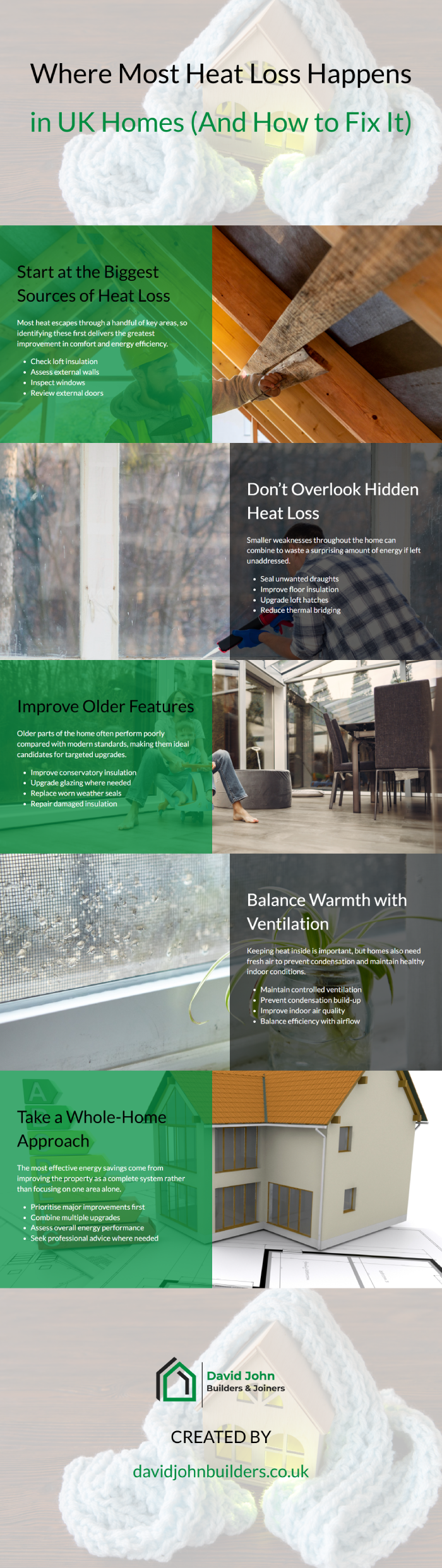
Heat Rises Through the Roof
One of the largest sources of heat loss in many homes is the roof. Warm air naturally rises, and without adequate insulation, a significant amount of heat can escape through the loft space.
Many older properties still have insufficient loft insulation by modern standards. Even where insulation exists, gaps, compression, or poor installation can reduce effectiveness.
Because heat naturally moves towards colder areas, an under-insulated roof effectively allows warmth to leak away throughout the winter months.
The roof is often one of the easiest areas to improve.
Insulation upgrades can provide noticeable benefits quickly.
Loft spaces offer excellent opportunities for energy improvements.
Preventing heat loss at the highest point of the house makes logical sense.
- Upgrade loft insulation where required
- Check for gaps and compressed insulation
- Improve coverage across the entire roof space
- Prioritise roof insulation as an early upgrade
External Walls Lose More Heat Than Many People Realise
Walls represent a large proportion of a property’s external envelope, which means they play a major role in heat retention.
Older solid-wall properties are particularly susceptible to heat loss because they lack the cavity insulation found in many newer homes.
Even cavity wall construction can perform poorly if insulation is missing, damaged, or incomplete.
Large surface areas create significant opportunities for heat transfer.
Wall performance influences comfort throughout the property.
Thermal improvements can make rooms feel noticeably warmer.
Energy efficiency depends heavily on wall construction.
- Assess wall insulation performance
- Consider cavity wall insulation where suitable
- Explore internal or external insulation options
- Address major thermal weaknesses
Windows Can Be Major Sources of Heat Loss
Windows are essential for natural light and ventilation, but they are also common points of thermal weakness.
Older single-glazed windows allow heat to escape much more readily than modern glazing systems. Even older double glazing may perform poorly compared with contemporary standards.
Draughts around frames can further increase heat loss.
The goal is not simply to retain heat but also to improve comfort.
Cold surfaces can affect room temperatures significantly.
Window performance influences energy efficiency throughout the year.
Modern glazing offers substantial improvements.
- Upgrade poor-performing glazing
- Improve seals around frames
- Reduce draughts and cold spots
- Consider energy-efficient window systems
External Doors Often Allow Heat to Escape
Doors are frequently overlooked when homeowners think about heat loss.
Older doors may contain little insulation, while gaps around frames can allow warm air to escape and cold air to enter.
Because doors are used regularly, wear and movement can gradually reduce their effectiveness.
Even small gaps can have a noticeable impact.
Air leakage contributes significantly to energy loss.
Improving door performance is often relatively straightforward.
Comfort increases when draughts are reduced.
- Upgrade poorly insulated doors
- Improve seals around frames
- Address visible draughts
- Maintain weatherproofing components
Floors Can Contribute to Heat Loss
Ground floors, particularly in older homes, can be significant sources of heat loss.
Suspended timber floors often allow cold air to circulate beneath the property, while uninsulated solid floors can conduct heat away from living spaces.
Many homeowners focus on walls and roofs while overlooking the importance of floor insulation.
Cold floors affect overall comfort.
Heat loss occurs in multiple directions.
Floor upgrades can improve both warmth and energy efficiency.
Thermal performance should be considered holistically.
- Assess floor insulation opportunities
- Address draughts beneath suspended floors
- Improve thermal performance where practical
- Enhance comfort underfoot
Draughts Create Hidden Energy Loss
Draughts can undermine even well-insulated homes.
Warm air escaping through gaps around windows, doors, loft hatches, pipe penetrations, and other openings increases heating demand and reduces comfort.
Air leakage is often one of the most cost-effective issues to address.
Small openings can create surprisingly large losses.
Draught-proofing often delivers immediate benefits.
Comfort improves alongside efficiency.
Air movement should be controlled carefully.
- Identify common draught sources
- Seal unnecessary air leakage points
- Improve weatherproofing measures
- Maintain appropriate ventilation balance
Chimneys Can Act as Heat Escape Routes
Open chimneys and unused fireplaces can allow large amounts of warm air to leave a property.
Even when not in use, chimney openings create pathways for air movement that reduce energy efficiency.
While ventilation remains important, unnecessary heat loss should be minimised.
Unused chimneys deserve attention.
Air movement contributes to thermal inefficiency.
Solutions should maintain appropriate airflow.
Comfort improves when losses are controlled.
- Assess unused chimney openings
- Install suitable chimney draught solutions
- Reduce uncontrolled air movement
- Balance efficiency with ventilation requirements
Thermal Bridging Reduces Overall Performance
Thermal bridging occurs when heat bypasses insulation through more conductive materials.
Common examples include structural elements, junctions between building components, and poorly detailed construction areas.
Even well-insulated homes can suffer efficiency losses if thermal bridges are not addressed.
Heat follows the path of least resistance.
Details matter as much as insulation thickness.
Performance depends on continuity.
Thermal bridges often remain hidden.
- Identify potential thermal bridge locations
- Improve continuity of insulation
- Address weak construction details
- Reduce unnecessary heat transfer
Poor Loft Hatches and Access Points Matter
Loft hatches are small compared with roofs and walls, but they can still contribute to heat loss if poorly insulated.
Older hatches often allow warm air to rise directly into colder roof spaces.
Improving access points is usually straightforward and cost-effective.
Small improvements can support wider efficiency efforts.
Every part of the building envelope matters.
Attention to detail produces better results.
Minor upgrades can have cumulative benefits.
- Improve loft hatch insulation
- Address gaps around access points
- Reduce air leakage into roof spaces
- Enhance overall thermal performance
Conservatories and Garden Rooms Often Lose Heat Quickly
Older conservatories are particularly prone to heat loss because of extensive glazing and limited insulation.
Many homeowners find these spaces uncomfortable during colder months because heat escapes faster than it can be retained.
Improving thermal performance can significantly increase usability.
Glazing quality influences performance greatly.
Comfort depends on controlling heat transfer.
Older structures often require targeted upgrades.
Year-round use becomes more achievable.
- Upgrade glazing where appropriate
- Improve roof insulation performance
- Address draughts and thermal weaknesses
- Enhance year-round comfort
Ventilation Must Be Managed Carefully
While reducing heat loss is important, homes still require adequate ventilation.
Poor ventilation can lead to condensation, mould growth, and indoor air quality issues.
The challenge is balancing energy efficiency with healthy airflow.
Airtightness alone is not the solution.
Ventilation and insulation must work together.
Healthy homes require fresh air.
Efficiency should not compromise wellbeing.
- Maintain appropriate ventilation levels
- Avoid sealing homes excessively
- Control moisture effectively
- Balance comfort and health requirements
Heating Systems Cannot Compensate for Excessive Heat Loss
Many homeowners focus on upgrading boilers or heating systems while leaving major sources of heat loss untouched.
Even the most efficient heating system will struggle if the building envelope performs poorly.
Reducing heat loss often improves results more effectively than increasing heat generation.
Efficiency begins with the building itself.
Heat retention reduces demand on systems.
Performance improvements should be prioritised logically.
The building envelope comes first.
- Improve insulation before upgrading heating
- Reduce energy demand where possible
- Support heating system efficiency
- Focus on whole-house performance
Energy Efficiency Works Best as a Whole-House Strategy
No single upgrade will eliminate heat loss entirely.
The most effective approach considers roofs, walls, floors, windows, doors, ventilation, and heating systems together.
Each improvement supports the performance of the others.
Homes function as integrated systems.
Combined upgrades deliver stronger results.
A holistic approach improves outcomes.
Long-term thinking supports greater efficiency.
- Assess the property comprehensively
- Prioritise improvements strategically
- Combine multiple efficiency measures
- Focus on overall building performance
Professional Assessments Can Identify Hidden Issues
Not all sources of heat loss are obvious.
Thermal imaging surveys, energy assessments, and professional inspections can identify weaknesses that may otherwise go unnoticed.
Targeted improvements often deliver better value than guesswork.
Accurate information supports better decisions.
Hidden problems are easier to solve when identified early.
Assessment helps prioritise spending effectively.
Professional expertise improves planning.
- Identify hidden thermal weaknesses
- Use evidence-based improvement strategies
- Prioritise the most effective upgrades
- Support long-term energy savings
Conclusion
Heat loss is one of the biggest factors affecting comfort, energy efficiency, and heating costs in UK homes. Roofs, walls, windows, doors, floors, draughts, and thermal bridges all contribute to the gradual escape of warmth from a property.
While no building can eliminate heat loss entirely, significant improvements are often achievable through targeted upgrades. Better insulation, improved glazing, effective draught-proofing, and thoughtful ventilation strategies can dramatically improve both comfort and efficiency.
The most successful energy-efficiency projects focus on retaining heat rather than simply generating more of it. By addressing the areas where losses are greatest, homeowners can reduce energy consumption while creating warmer and more comfortable living environments.
Ultimately, understanding where heat escapes is the first step towards keeping it where it belongs. When the building envelope performs effectively, every part of the home benefits from improved comfort, reduced costs, and better long-term performance.